

Guest lectures
July 25: A Reading and Conversation with Herta Müller
*The following is an article from Britannica.
Herta Müller (https://www.britannica.com/biography/Herta-Muller), Müller also spelled Mueller, (born August 17, 1953, Nițchidorf, Romania), Romanian-born German writer who won the Nobel Prize for Literature in 2009 for her works revealing the harshness of life in Romania under the dictatorship of Nicolae Ceaușescu. The award cited Müller for depicting “the landscape of the dispossessed” with “the concentration of poetry and the frankness of prose."
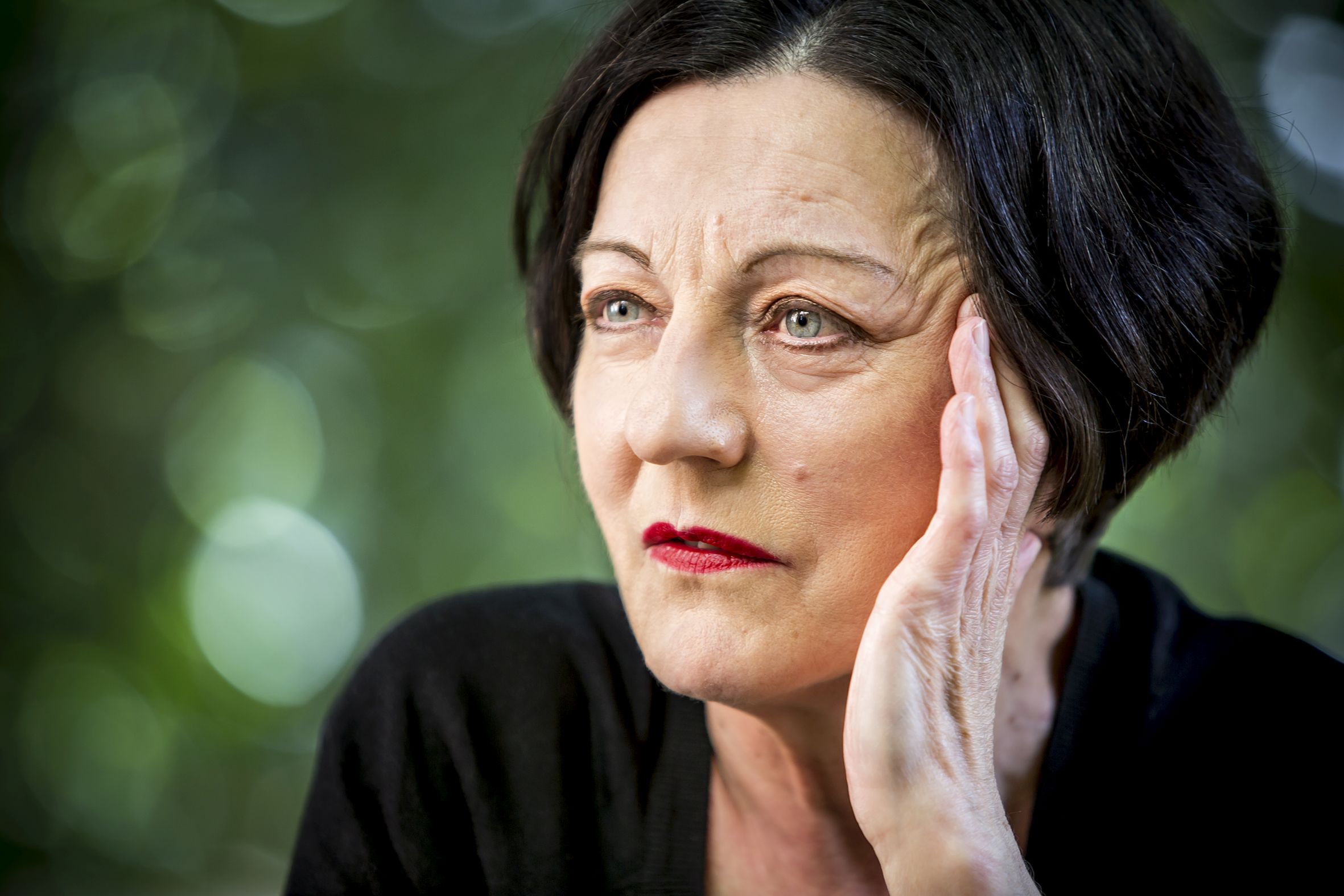
© Stephanie von Becker
Müller, of German Swabian descent, grew up in Banat, a German-speaking region of totalitarian Romania. She attended the University of Timișoara and, as a student, became involved with Aktionsgruppe Banat, a group of writers fighting for freedom of speech. After graduating, she worked from 1977 to 1979 as a translator at a machine factory, a job from which she was fired for refusing to cooperate with the Securitate, the notoriously vast and ruthless Romanian secret police. Her first book, a collection of short stories titled Niederungen (1982; Nadirs), was censored by the Romanian government, but she won a following in Germany when the complete version of the book was smuggled out of the country. After publishing a second book of stories, Drückender Tango (1984; “Oppressive Tango”)—which, like her first collection, depicted frankly the general misery of life in a small Romanian village similar to her own German-speaking hometown—she was forbidden to publish again in Romania, and in 1987 she emigrated with her husband, author Richard Wagner, and moved to Germany.
Her first novel, Der Mensch ist ein grosser Fasan auf der Welt (The Passport), was published in Germany in 1986. Although her circumstances had changed, her work continued to present and examine the formative experiences of her life: themes such as totalitarianism and exile pervade her work. Her style was described by Romanian journalist Emil Hurezeanu as “lively, poetic, [and] corrosive.” Among Müller’s later novels were Reisende auf einem Bein (1989; Traveling on One Leg), Der Fuchs war damals schon der Jäger (1992; The Fox Was Ever the Hunter), Herztier (1994; The Land of Green Plums), and Heute wär ich mir lieber nicht begegnet (1997; The Appointment). In 1998 Müller received the International IMPAC Dublin Literary Award (the world’s richest literary prize) for The Land of Green Plums. The novel Atemschaukel (The Hunger Angel) was published in 2009.
In addition to fiction, she published volumes of poetry and essays, including in the latter category Hunger und Seide (1995; “Hunger and Silk”), Der König verneigt sich und tötet (2003; “The King Bows and Kills”), and Immer derselbe Schnee und immer derselbe Onkel (2011; “Always the Same Snow and Always the Same Uncle”).
July 18: Alfred Hornung, “Politics and World Literature: The Case of Confucius”
Why did the third president of the United States, Thomas Jefferson, include in his Scrapbooks a poem from the Book of Odes com

piled by the Chinese philosopher Confucius in the 5th century BCE which praises Prince Wei as an exemplary leader? My discussion of this question about the reverberations of Confucius’ work in politics and literature around the world will focus on three areas of cross-cultural interrelations between China and the West. The first one is connected to the repercussions of the publication of the Latin translation of his works in 1687 on Enlightenment writers and their implicit contributions to political transformations in Europe and America. The second one analyzes the importance of Confucian ideas in the concept of modern literature, focusing on Ezra Pound’s poetic and political mission which deliberately counteracted the demise of the Confucian tradition in the First Chinese Republic. The third area will consider the recovery of Confucius after Mao Zedong and the institution of Confucius Institutes as a new cultural diplomacy, now contested worldwide.
Alfred Hornung is Research Professor of American Studies and Speaker of the Obama Institute at the University of Mainz. He is a specialist in transcultural life writing, narrative medicine, and Transnational American Studies. His recent publications include the Chinese translation of Ecology and Life Writing (2016), a biography of Jack London as a cosmopolitan writer (2016), and the co-edited Routledge Companion to Transnational American Studies (2019). His biography of Al Capone will appear in March 2021. He is the recipient of the Bode-Pearson Prize of the American Studies Association, a member of Academia Europaea and of the IWL Advisory Board, and an Honorary Chair Professor of Shandong University.
July 20: Mita Banerjee, "World Literature, Gender and Migration in Elif Shafak’s 10 Minutes 38 Seconds in This Strange World "
This talk sets out to relate the concept of world literature to “thanatic ethics.” As critics such as Judith Butler and Bidisha Banerjee have argued, states have come to make a distinction between lives we can mourn and those for which we do not grieve. Relating these i

ssues to Elif Shafak’s novel 10 Minutes 38 Seconds in This Strange World, I will argue that world literature may possess a key function: Literary texts can become an alternative site of mourning. In her novel, Shafak tells the life story of her protagonist, Leyla, backwards: Her narrative reconstructs the time when, from the perspective of the dominant culture, Leyla has crossed the line between morality and immorality, and has allegedly forfeited the right to be included in society. However, the novel proceeds to turn this exclusion on its head by creating an alternative community: Leyla’s “water family.” Shafak’s narrative connects questions of migration, gender and citizenship to create an alternative polis, and an alternative politics of mourning. Her literary ethics connect Turkey, Europe and the Mediterranean, and makes us reconsider what we mean by the “world.”
Mita Banerjee is Professor of American Studies at the Obama Institute for Transnational American Studies at Mainz University. In her research, she has focused on questions of naturalization and citizenship, whiteness, indigeneity, and the role of narratives in the field of medicine. Her publications include Color Me White: Naturalism/Naturalization in American Literature (2013) and Medical Humanities in American Studies: Narrative Medicine, Life Writing, and the Power of Autobiography (2018). She is a member of the Collaborative Research Unit “Human Differentiation” and co-speaker of the research training group “Life Sciences, Life Writing: Boundary Experiences of Human Life between Biomedical Explanation and Lived Experience,” which is funded by the German Research Foundation.